Pilates, Misunderstood

Pilates will often overlap with other healing modalities. People have often commented that they did similar exercises with their PT; in this way, Pilates can be practiced with the goal to heal through carefully targeted movements. But Pilates cannot be reduced to healing injury and focus only on the injury. Pilates designed in this way will bore those who recover successfully, especially if this style is the basis for teaching Pilates. It won't do justice to Joseph Pilates' original method, and will soon seem too easy for clients. Instructors will often address this boredom by adding in more stretches and mixing in elements from yoga, all the while calling what they do yoga. I have a language analogy for this, but I will save it for later.
Once yoga elements have been added to a Pilates workout, the client, and consumers in general, will become confused about what Pilates actually is. We see this often in how the advertising and business world sells yoga and Pilates products to the same crowd. Toe socks? Mat? Leggings? The list goes on…
For the consumer used to this type of hybrid (read: diluted) form of Pilates, when they actually try the original exercises from Return to Life, they will find those exercises too hard. I can see how tempting it would be to substitute out trickier exercises with squats and planks. Enter HIIT-style workouts that are now calling themselves Pilates classes. I haven't really touched equipment yet. We're just working with our body weight. “Oh, so is it calisthenics?” Well, not exactly! It's a definable practice with a clear beginning and an end, like a song you know well.
And like anyone who knows a particular song well, you know all the remixes and remakes, some of which you might like, some of which you might hate.
Return to Life is a small thing book with pictures and descriptions of 34 exercises that Joseph Pilates practiced and taught throughout his life. It was pure exercise: he could have called his book “The Joy of Movement.” Instead, he called his method, “Contrology,” which brings together “control” and “the study of.” This goes deeper than moving for the sake of moving, which is not a bad thing. We're simply going deeper, into a complex web of “how” and “why.” These two lines of inquiry change everything. Beyond the exercises, the form, and the reps, there is an intricate relationship between why we do an exercise the way we do: simply put, to go deeper into the core and use our full-body connection. If you are in the right spot at the right time, the two goals will align perfectly and you will only feel one sensation and not two separate goals: introducing the two-way stretch. If I only focus on form and disregard the entire order, the whole method, the entire system of Pilates, I’m left with the extremes: I only focussed on the hard stuff, made sure my form was good and got killer DOMS as my reward. I must have done something right.
Spoiler alert: harder is not better. I worked with a woman who took class with Joseph Pilates when she first arrived in New York in the early 40s. In the 60s, she told me, a group of people practiced Pilates on the hard floor in the basement of the campus gym at IU. Some even hurt their backs.
Let's return to “Contrology,” the study of control. This is practiced through movement, with clear parameters. Not mere movement for movement’s sake (if that were the case, we could stand in those bizarre contraptions that shake our body, promising better muscle tone while we stand still), and not mere form (brace your core and do 12 reps won't cut it with Pilates exercise, not if you are doing it correctly).
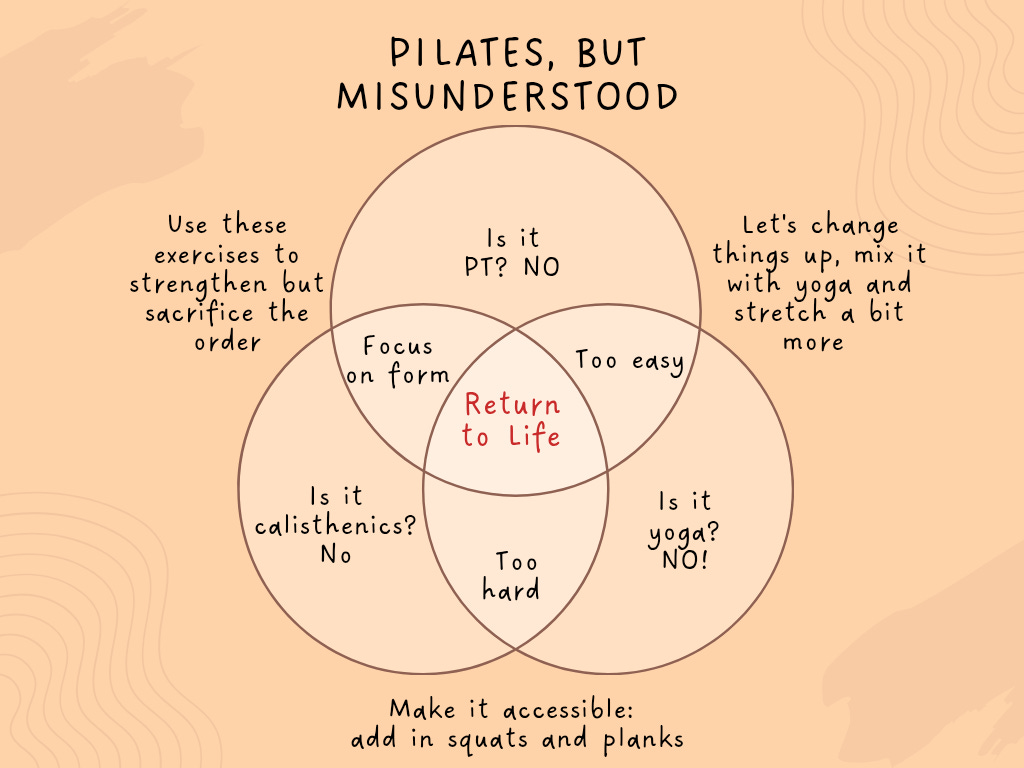
I will stop here because this diagram brings together all the ways I have seen people misunderstand Pilates. I truly get where they are coming from. Pilates is so different, it has a movement vocabulary all its own. It is truly a new language. So that analogy? Imagine signing up for a foreign language course. Let's say Spanish, just for fun, and for some reason, the instructor decides that many concepts in that language are difficult, or maybe they didn't go beyond learning the present tense. Let's borrow from other languages now and we won't tell the students. The students think they are learning everything Spanish in their Spanish class, which they paid for, but only a true Spanish speaker knows that these students are not learning Spanish. The instructor has been teaching them Japanese.
The world of Pilates has entered into its Tower of Babel era. I hear then arguments from all sides and can empathize with several perspectives. But let's keep things simple.
When in Rome, do Pilates, and all that jazz.
If I want something else, I will do it. Pilates does not have a monopoly on movement or my freedom. In fact, just the opposite: the study of control was designed to strengthen us and make everything else we do that much better. It is the ultimate auxiliary verb in the world of fitness and artistic movement. It gives us physical and mental range in a world that would sell us a bill of rights. When done with integrity, the Pilates system pays you back a hundredfold. This is no fad. It truly has stood to test of time and will continue to do so for future generations.
Posting on Substacks for the first time and I am just now catching a few mistakes. No editing button? Oh well 😄